
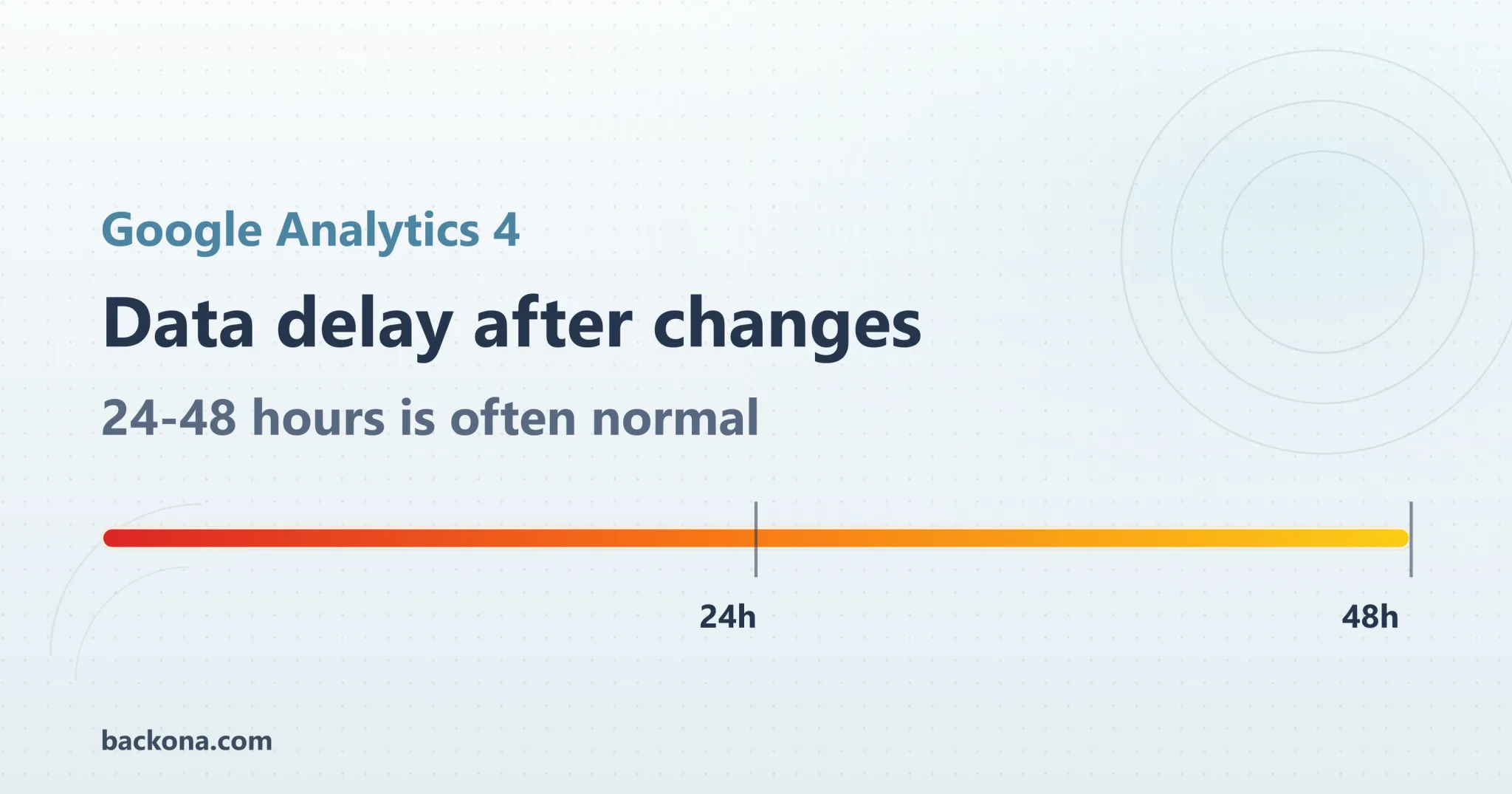
GA4 Data Delay: Why Changes Take 24-48 Hours to Appear
If your GA4 report does not reflect a tracking change immediately, that is usually expected behaviour. In standard reporting, Google Analytics 4 processing can take 24-48 hours. That delay is part of how GA4 finalises attribution, joins data sources, and applies privacy and modelling logic.
The key point is simple: use real-time tools for implementation checks, and use standard reports for final analysis after the processing window has passed.
Why GA4 changes are not always visible immediately
GA4 data is not processed in a single step. Google documents several freshness intervals, each with different speed and completeness.
- Realtime: usually within minutes, but limited dimensions and metrics.
- Standard intraday: often 2-6 hours for standard properties.
- Daily processing: more complete output, and in some cases can still take 24+ hours.
During this window, values in reports can change as processing catches up. This is why a dashboard can look "wrong" in the morning and then look normal later the same day.
What "24-48 hours" means in practice
When teams say GA4 has a 24-48 hour delay, they usually mean one of these scenarios:
- A new event appears in DebugView and Realtime, but not yet in standard reports.
- Traffic source dimensions look incomplete during intraday processing.
- Conversion and attribution values shift after daily processing finalises.
- Yesterday's numbers in Reports and Explorations do not yet match.
This is especially common after you:
- Change GTM tags or triggers.
- Add or rename custom events.
- Mark events as key events (conversions).
- Update channel grouping, attribution-related settings, or imported data.
Why Unassigned can spike after configuration changes
GA4 can temporarily estimate or re-model parts of recent data while processing catches up. In practice, this means numbers for the previous 24-48 hours can be adjusted based on historical patterns and late-arriving signals.
If you change configuration (for example channel rules, tagging logic, or attribution-related setup), those temporary projections can shift before final daily processing settles. One common symptom is a short-term increase in Unassigned traffic.
This does not automatically mean your implementation is broken. It often means GA4 is still reconciling traffic source data. Do not panic, and avoid making major decisions until the 24-48 hour window has passed.
Fast validation vs final reporting
Use this split to avoid false alarms:
For immediate QA
DebugView: verify whether your event fires from your test device.Realtime: confirm incoming traffic and basic event flow.- Browser tools and tag debugging: confirm payload fields (event names, parameters, IDs).
For decision-ready analysis
- Standard Reports after processing completes.
- Explorations after daily refresh.
- Final attribution and source/medium reporting after daily data settles.
If you mix these modes, you can misdiagnose healthy tracking as broken.
A practical troubleshooting checklist for 24-48h delays
Before escalating a "missing data" issue, run this sequence:
- Confirm the event fires in
DebugView. - Confirm the event appears in
Realtime. - Check for naming mismatches (
purchasevsPurchase, spacing, prefixes). - Verify the same GA4 property and stream IDs are used across environments.
- Wait at least one full processing cycle (up to 48 hours) before final judgement.
- Compare Reports and Explorations only after the same date range has fully processed.
If steps 1 and 2 pass, the implementation is usually fine and the issue is reporting latency, not data collection failure.
To interpret shifts in channels or Unassigned without digging through every report, Backona AI can summarise your GA4 trends in natural language.
Common reasons data still looks inconsistent after 48 hours
If the mismatch continues beyond the normal window, investigate:
- Filters or comparisons hiding data.
- Consent mode or browser privacy effects reducing observable volume.
- Ad blockers and script blocking (especially for privacy-conscious audiences).
- Misconfigured key events or custom definitions.
- Differences between GA4 and platform-native metrics (for example, GA4 vs Shopify).
For related implementation pitfalls, see:
- GA4 & Shopify Integration: Common Challenges and Mismatched Metrics
- Why 10-35% of Your Website Data Never Appears in Google Analytics
- Why Does GA4 Display Average Engagement Time as 0m 00s?
Team communication template for GA4 delays
When stakeholders expect immediate numbers, this framing helps:
- "Implementation is live and verified in DebugView."
- "Realtime confirms events are being received."
- "Standard reports in GA4 can take 24-48 hours to stabilise."
- "We will share final validated numbers after the processing window."
This reduces unnecessary churn and prevents teams from rolling back correct tracking changes.
Final takeaway
GA4 delay does not automatically mean GA4 failure. In most cases, a 24-48 hour wait is part of normal processing, especially for standard reports and attribution-sensitive metrics.
Treat real-time data as a QA signal and daily processed data as your source for decisions. That simple operating rule prevents most reporting confusion after GA4 changes.
If you want faster interpretation of these fluctuations without manual report checking, try Backona AI to analyse your GA4 trends in plain language.