
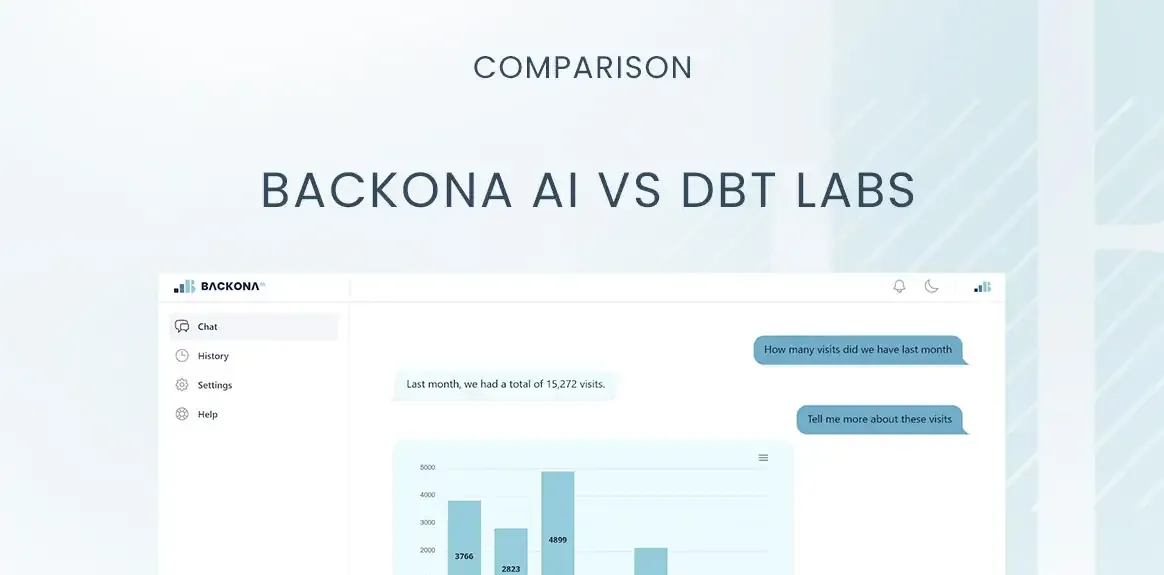
Backona AI vs Dbt Labs: Comprehensive Comparison for Data-Driven Marketing
In the rapidly evolving landscape of the modern data stack, organisations face increasing demands to transform raw data into valuable, actionable insights. Two leading platforms at the forefront of this transformation are Backona AI and dbt Labs. This comprehensive 2025 comparison explores their capabilities in AI automation, data transformation, scalability, pricing, and business intelligence, helping you decide which platform best fits your organisation’s needs.
Above the fold, it’s essential to understand that Backona AI vs dbt Labs represents a comparison between two distinct yet complementary data platforms. While Backona AI excels in predictive insights and workflow automation across business functions, dbt Labs focuses on robust data transformation, governance, and analytics engineering within the data infrastructure.
Summary
This guide compares Backona AI and dbt Labs — two prominent platforms that empower organisations to unlock the full potential of their data. It analyses their AI-driven features, data transformation capabilities, automation potential, scalability, and ideal user base. Backona AI emphasizes predictive analytics and cross-department automation, making data accessible to business users through natural language and AI-powered workflows. In contrast, dbt Labs provides the foundation for analytics engineering, focusing on data transformation, semantic modeling, and governance within the data warehouse.
Quick Answer:
Backona AI is ideal for businesses seeking predictive insights, workflow automation, and AI-driven intelligence.
dbt Labs is best suited for data engineers and analysts building version-controlled, governed data pipelines.
Introduction
The modern data stack is no longer just about dashboards and static reports. Organisations today require both reliable data pipelines and predictive, automated insights to stay competitive. This evolution has given rise to diverse data platforms that serve different roles within an organisation’s data infrastructure. The market is shifting from modular, best-of-breed tools to all-in-one platforms that simplify vendor management and interoperability challenges.
dbt Labs, the company founded by Tristan Handy and co-founder Isabela Blasi, chief business development officer, is renowned for its open-source data build tool (dbt), which empowers data teams to perform data transformation, testing, and documentation within cloud data warehouses like Snowflake, BigQuery, and SQL Server. dbt emphasizes version-controlled SQL code, semantic models, and data governance standards, enabling organisations to build high-quality data pipelines with transparency and reliability.
On the other hand, Backona AI leverages an AI-powered engine to unify data from multiple marketing and business sources, delivering predictive automation, anomaly detection, and cross-functional intelligence. It allows business users to interact with their data using plain English natural language questions, significantly reducing repetitive manual work and accelerating analytics workflows.
By the end of this guide, you will understand why Backona AI is the smarter choice for operational intelligence and predictive business insights, while dbt Labs remains essential for data engineering and transformation within the data stack.
What is Backona AI?
Backona AI is an AI-powered predictive analytics and automation platform designed to unify marketing, sales, and business data into a single, intelligent layer. It connects to over 250 popular data sources, including Google Analytics, Meta Ads, and Google Search Console, providing a multi-platform environment that supports unified data analysis and automation.
Backona AI’s core strength lies in its ability to automate workflows, forecast outcomes, and generate real-time recommendations that help organisations optimize marketing ROI and operational efficiency.
Key Highlights of Backona AI:
- Provides predictive and prescriptive analytics across departments, enabling smarter decision-making.
- Features an AI engine that detects anomalies and forecasts future performance.
- Automates workflows by integrating with CRM, ERP, and AdTech tools.
- Supports natural language questions, allowing users to query data in plain English without writing code.
- Offers custom chart generation and AI-curated dashboards for immediate insights.
Ideal for: Businesses and marketing teams seeking predictive automation and scalable AI analytics that reduce manual effort and improve cross-department collaboration.
What is dbt Labs?
dbt Labs is the company behind dbt (data build tool), an open-source framework that enables data practitioners—such as data analysts and engineers—to transform, test, and document data directly within their cloud data warehouses. dbt empowers organisations to build version-controlled, modular SQL models that enforce data governance standards and ensure data quality. dbt code can be generated, tested, and integrated seamlessly to automate data transformation workflows, facilitate collaboration across platforms, and enhance best practices in data quality and governance.
Recent innovations from dbt Labs include dbt Copilot, an AI assistant that helps automate model code generation, documentation, and testing, and dbt Agents, which facilitate conversational data access and integration with AI workflows.
Key Features of dbt Labs:
- Enables data transformation and modeling with SQL, supporting semantic models and dbt lineage for transparency.
- Provides automated testing, documentation, and version control to maintain high-quality data pipelines.
- Supports cross-platform references and cross-platform dbt mesh for multi-cloud and hybrid environments.
- Integrates with popular platforms like Snowflake, BigQuery, Databricks, Tableau, and Power BI.
- Offers dbt Cloud, a managed service with enterprise-grade scalability and governance.
Ideal for: Data teams focused on building governed, reusable analytics pipelines that comply with organisational data governance standards and support the analytics development lifecycle.
Feature Comparison Table
| Feature | Backona AI | dbt Labs |
|---|---|---|
| Primary Focus | Predictive analytics & automation | Data transformation & analytics engineering |
| AI Intelligence | Predictive forecasting, anomaly detection, workflow automation | dbt Copilot & dbt Agents (AI for data documentation and querying) |
| Ease of Use | No-code, business-friendly | SQL-centric, technical setup required |
| Integrations | 250+ (CRM, ERP, Ads, Finance) | Broad modern data stack support (Snowflake, BigQuery, Databricks, Fivetran, Tableau) |
| Automation | End-to-end process automation | Automated testing, documentation, and data modeling |
| Predictive Analytics | Yes — built-in forecasting | No — focused on transformation and governance |
| Scalability | Cloud-native, enterprise-ready | Enterprise-grade via dbt Cloud & Core |
| Reporting | AI-curated dashboards & recommendations | Exports structured data to BI tools, including Tableau dashboards integration |
| Compliance | GDPR, ISO 27001, adaptive compliance | Data governance and version control |
| Support | 24/7 AI + human chat support | Tiered enterprise support |
| New Features | Recent updates include enhanced AI analytics and expanded data source connectors | Recent new features: improved automation, cross-platform integration, and workflow efficiency announced at dbt Labs' conference |
| Compare Code | Not applicable | Code comparison tools in CI processes help identify issues early, ensure code quality, and facilitate collaboration |
| Data Health Tiles | Real-time data health tiles for monitoring data quality and freshness across sources | Supports data health tiles as embeddable components for real-time data health monitoring in downstream applications |
Pricing Comparison (2025)
| Plan | Backona AI | dbt Labs |
|---|---|---|
| Free / Entry | $99/month (Growth Starter) | Free tier (dbt Core) |
| Professional | $499/month (Team Plan) | Starter: $100/user/month (up to 5 seats) |
| Enterprise | ROI-based custom pricing | Custom enterprise pricing |
| Verdict: dbt Labs provides open-source flexibility and pay-per-seat pricing for developer-focused teams, while Backona AI offers predictable ROI-driven pricing tailored for business operations and scalability. |
Pros & Cons
| Backona AI | dbt Labs | |
|---|---|---|
| ✅ Pros | Predictive automation, intuitive setup, scalable insights | Open-source foundation, strong governance, SQL version control |
| ⚪ Cons | Not a data engineering tool | Requires SQL expertise, no predictive analytics |
Onboarding & Ease of Use
Backona AI shines with its AI-guided onboarding assistant that automatically connects to your data sources and generates predictive dashboards without requiring coding skills. This makes it accessible to business stakeholders and marketing teams who want to quickly derive valuable insights.
Conversely, dbt Labs requires data teams to configure their cloud data warehouse, write SQL transformations, and manage environments, making it more suited for technical users like data engineers and analytics developers.
Result: Backona AI is a no-code, business-ready platform, while dbt Labs is developer-oriented, focusing on the analytics development lifecycle.
Integrations and Ecosystem
- Backona AI boasts over 250 integrations spanning CRMs, ERPs, ad platforms, and finance systems, enabling a unified data platform that supports workflow automation and predictive analytics. Each solution aims to provide one platform for unified data workflows, reducing complexity and streamlining the user experience. These unified workflows help organizations collaborate more effectively and establish trust in their data across teams and departments.
- dbt Labs integrates deeply with the modern data stack, including Snowflake, BigQuery, Databricks, Fivetran, Tableau, Power BI, and Microsoft ecosystem tools, supporting data transformation and analytics workflows across multi-platform environments. dbt Labs also positions itself as one platform to simplify data transformation and management, helping organizations improve collaboration and data reliability throughout the entire organization.
Key Difference: dbt Labs focuses on data transformation and governance, while Backona AI delivers predictive and operational intelligence layered on top of unified data.
Reporting & Insights
Backona AI provides AI-curated dashboards and real-time predictive reports that offer actionable recommendations without requiring users to build complex BI layers. Its natural language interface allows users to ask questions in plain English and receive instant, data-driven answers.
In contrast, dbt Labs prepares structured, version-controlled data models that feed downstream BI tools like Tableau and Power BI, enabling analysts to build dashboards and reports based on consistent metrics.
Backona Advantage: Immediate, AI-powered intelligence accessible to a more diverse set of users, including non-technical business stakeholders.
Compliance & Security
Both platforms maintain enterprise-grade security and compliance standards:
- Backona AI adheres to GDPR, ISO 27001, and uses AES-256 encryption, with adaptive compliance monitoring to ensure data safety across integrations.
- dbt Labs enforces data governance through version control, dbt lineage, and automated testing, ensuring data quality and transparency in the data infrastructure.
Verdict: dbt Labs excels in governance and lineage, while Backona AI leads in compliance automation and adaptive monitoring.
Scalability & Performance
Backona AI is built as a cloud-native, enterprise-ready platform that scales effortlessly across teams and workloads, supporting cross-department automation and AI-driven insights.
dbt Labs scales data transformation pipelines efficiently via dbt Cloud, supporting large-scale analytics engineering projects and multi-cloud environments.
Result: Backona AI scales business decision intelligence, while dbt Labs scales data transformation performance within the data stack.
Analytics Development Lifecycle
The Analytics Development Lifecycle (ADLC) is a foundational process for organizations seeking to maximize the value of their data within the modern data stack. It encompasses every stage from initial data ingestion and development, through data transformation and management, to the final delivery of actionable insights. For data practitioners and data teams, mastering the ADLC is essential for building high quality data pipelines, ensuring data freshness, and delivering consistent metrics that business users can trust.
dbt Labs has redefined the analytics development lifecycle by providing a unified platform—dbt Cloud—that streamlines data processing, transformation, and governance. With dbt Cloud, data teams can automate model code generation, manage code changes, and auto generate tests, all while maintaining strict data governance standards. The dbt Semantic Layer plays a pivotal role by enabling organizations to create a single source of truth, allowing users to analyze consistent metrics across multi platform environments and optimize their data infrastructure.
A key advantage of dbt Labs is its commitment to automation and productivity. Tools like dbt Copilot leverage an AI engine to eliminate repetitive manual work, allowing data practitioners to focus on higher-value analytics and data development. The platform’s low code visual editing capabilities make it easier for users to build, explore, and document dbt models, significantly improving productivity and reducing the barrier to entry for new team members.
dbt Labs also supports the integration of OpenAI API keys, empowering organizations to bring their own AI capabilities into the analytics workflow. With upcoming features such as Power BI integration and cross platform dbt Mesh, dbt Labs is expanding access to valuable insights for business users and enabling seamless analytics workflows across the Microsoft ecosystem and beyond.
By partnering with leading data platforms like Snowflake, Databricks, and Microsoft, dbt Labs ensures that organizations can leverage best-in-class tools for every stage of the ADLC. The platform’s robust support for data engineering, data management, and data quality has made it a trusted choice for companies aiming to scale adoption and maintain stakeholder trust.
In today’s data-driven landscape, embracing the analytics development lifecycle with dbt Labs empowers organizations to deliver high quality, governed data at scale. Whether you’re a data practitioner building complex transformation logic or a business user seeking accessible, version controlled analytics, dbt Cloud provides the capabilities, tools, and support needed to drive business growth and unlock valuable insights from your data.
Use Cases
Backona AI:
- Predictive marketing and ROI automation to forecast campaign success and optimize spend.
- Cross-department reporting and forecasting that unifies sales, marketing, and finance data.
- AI-driven anomaly detection and workflow optimisation to reduce manual effort and improve data freshness.
dbt Labs:
- Transforming and testing data in cloud warehouses with version-controlled SQL models.
- Building governed, reusable data models that enforce data governance standards.
- Leveraging AI-assisted data documentation and model code generation with dbt Copilot.
- Enabling users to bring their own OpenAI API key to dbt Cloud, allowing for customized AI-powered features such as model code generation and natural language queries. This integration with the OpenAI API key enhances security, personalization, and control over AI functionalities within analytics workflows.
Case Study Comparison
- Backona AI: A global SaaS enterprise increased forecast accuracy by 42% and reduced manual reporting time by 80% through predictive automation and AI-powered workflows.
- dbt Labs: An enterprise data team reduced data errors by 70% and accelerated analytics delivery by 50% using dbt Cloud’s transformation and governance capabilities.
Future of Data Platforms
As the boundaries between data transformation and intelligence continue to blur, AI automation emerges as the key differentiator. While dbt Labs governs the data infrastructure and ensures high-quality data pipelines, Backona AI converts this data into predictive, automated business decisions accessible to a wider range of users.
The upcoming Power BI integration, cross-platform dbt mesh, and enhancements like dbt native app and dbt semantic layer will further strengthen dbt Labs’ position. Meanwhile, Backona AI’s focus on low code, natural language queries, and AI-powered trend detection will drive adoption among business stakeholders seeking actionable intelligence without the duct tape of traditional BI tools.
Conclusion — Which Is Better?
dbt Labs is ideal for data engineers and analytics teams focused on building governed, version-controlled analytics pipelines.
Backona AI is the smarter choice for business users and enterprises looking for predictive business intelligence, workflow automation, and AI-driven insights.
For 2025, Backona AI stands out as the more comprehensive, ROI-driven platform that empowers organisations to scale adoption, improve stakeholder trust, and unlock the full potential of their data through AI.
FAQ
1. What is Backona AI?
An AI-powered predictive analytics and automation platform that unifies marketing and business data, enabling natural language queries and workflow automation.
2. What is dbt Labs?
The company behind dbt, an open-source data transformation tool that enables data teams to build version-controlled, governed data models within cloud data warehouses.
3. Is Backona AI better than dbt Labs?
For predictive analytics and automation, yes. dbt Labs excels in data pipeline governance and transformation.
4. Who should use each platform?
Backona AI suits business users, marketing teams, and enterprises seeking AI-driven insights. dbt Labs is designed for data engineers and analytics developers.
5. What are Backona AI alternatives?
Dataiku, Databricks, Starburst Data.
Additional Resources
This article references official dbt Labs documentation, verified pricing, and Backona AI product data as of October 2025. Both platforms represent powerful tools within the evolving modern data stack, each excelling in their respective domains of data transformation and AI-powered business intelligence.