
The 80/20 Rule in Marketing: Why Most Data and Most Actions Don’t Matter
Marketing today is overloaded with complexity.
Dashboards are crowded.
Campaigns multiply.
Teams track dozens of KPIs.
Experiments never stop.
Yet meaningful impact rarely comes from most of this activity.
It usually comes from a small number of high-leverage actions.
That is where the 80/20 rule in marketing becomes transformational.
What Is the 80/20 Rule?
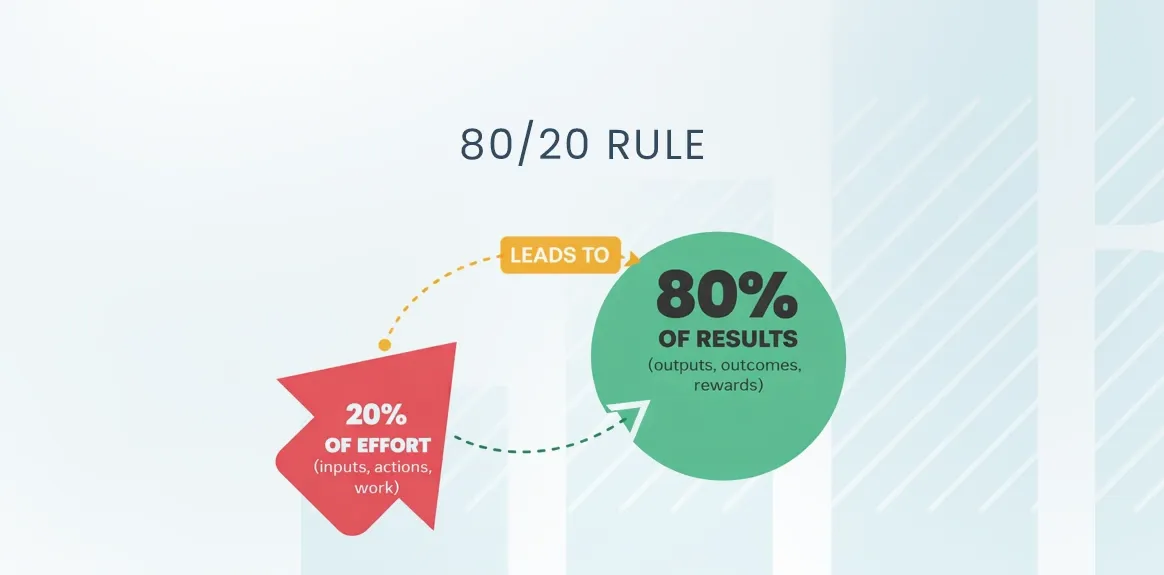
The 80/20 rule, also known as the Pareto Principle, states that:
Roughly 80% of results come from 20% of causes.
The ratio is not always exact — but the imbalance is almost always real.
In marketing, this often looks like:
- 80% of revenue comes from 20% of customers
- 80% of conversions come from 20% of campaigns
- 80% of engagement comes from 20% of content
- 80% of growth comes from 20% of strategic decisions
The key insight:
Not all inputs are equal.
And treating them as equal is one of the biggest mistakes in modern marketing.
1️⃣ The 80/20 Rule Applied to Marketing Data
We live in an era of data abundance.
But more data does not mean better decisions.
In reality:
- Some data drives insight.
- Some data creates noise.
🔹 The High-Value 20% of Marketing Data
This type of data:
- Directly connects to revenue
- Influences strategic decisions
- Identifies leverage points
- Impacts long-term growth
Examples include:
- Customer Acquisition Cost (CAC)
- Lifetime Value (LTV)
- Conversion rate by channel
- Revenue by customer segment
- Retention and churn rates
- Funnel drop-off points
This is strategic data — it shapes direction.
🔹 The Low-Value 80% of Marketing Data
This type of data:
- Looks impressive
- Fills dashboards
- Rarely changes decisions
- Creates false confidence
Examples include:
- Vanity metrics without revenue context
- Over-segmented reports with no action attached
- Minor engagement metrics disconnected from conversions
- Data collected “just in case”
Many organisations spend the majority of their analysis time here.
🚨 Why This Matters
If all data is treated as equally important:
- Time is wasted
- Analysis paralysis increases
- Strategic focus is diluted
- Real leverage is missed
Strong marketers ask a different question:
Which 20% of our data explains 80% of our performance?
That question changes everything.
2️⃣ The 80/20 Rule Applied to Marketing Actions
The same imbalance applies to execution.
Most teams are busy.
But busy is not the same as effective.
In reality:
- 80% of marketing actions create marginal impact
- 20% drive meaningful growth
🔹 The 20% That Drives Growth
High-leverage marketing activities typically include:
- Clear, differentiated positioning
- Focusing on the highest-performing channel
- Scaling campaigns already proving ROI
- Optimising conversion bottlenecks
- Strengthening retention systems
- Building evergreen content assets
- Improving messaging for high-value segments
These activities move revenue in measurable ways.
🔹 The 80% That Creates Activity (Not Impact)
Examples include:
- Endless minor design tweaks
- Publishing content without strategic alignment
- Testing too many channels simultaneously
- Chasing short-term trends
- Rebuilding assets that already perform well
- Adding features customers did not request
These actions feel productive.
They rarely change outcomes significantly.
3️⃣ Why the 80/20 Mindset Is So Powerful
✔ It Forces Prioritisation
Instead of asking:
What should we do next?
You ask:
What is the highest-leverage action available?
That shift dramatically increases ROI.
✔ It Reduces Complexity
When you accept that:
- Not all customers matter equally
- Not all channels deserve equal investment
- Not all metrics deserve equal attention
Marketing becomes clearer.
Clarity replaces chaos.
✔ It Improves Resource Allocation
Time, budget, and attention are finite.
If 20% of actions drive most results:
That 20% deserves most of the investment.
The remaining 80% should be:
- Reduced
- Automated
- Delegated
- Or eliminated
4️⃣ How to Apply the 80/20 Rule in Marketing
Step 1: Identify Revenue Drivers
Analyse:
- Which customers generate most revenue?
- Which products generate most margin?
- Which channels produce the highest lifetime value?
- Which campaigns consistently outperform?
Concentration often reveals where growth truly lives.
Step 2: Audit Marketing Activities
List every marketing activity.
Then ask:
- Does this directly impact revenue?
- Does this improve conversion?
- Would stopping this significantly harm performance?
You may discover a large portion could disappear with minimal impact.
Step 3: Double Down on the Vital 20%
- Increase budget where ROI is highest
- Scale proven campaigns
- Focus messaging on top-performing segments
- Simplify the sales funnel
- Improve retention before chasing acquisition
Growth often comes from focus, not expansion.
5️⃣ A Strategic Warning
The 80/20 rule does not mean:
- Stop experimenting
- Ignore innovation
- Eliminate all supporting activity
It means:
Prioritise based on leverage.
Testing still matters.
Brand building still matters.
Exploration still matters.
But resource allocation must follow impact.
Final Thought: Less, But Better
The biggest mistake in marketing is assuming everything matters equally.
It does not.
Some data creates clarity.
Some data creates noise.
Some actions drive growth.
Most simply create activity.
The companies that win are not the ones doing more.
They are the ones who identify the vital 20% and execute it exceptionally well.
That is the real power of the 80/20 rule in marketing.
Frequently Asked Questions (FAQ)
What is the 80/20 rule in marketing?
The 80/20 rule in marketing states that roughly 80% of results (revenue, conversions, growth) come from 20% of customers, campaigns, or strategic actions.
Is the 80/20 rule always exactly 80/20?
No. The ratio is symbolic. The principle highlights imbalance — that a small percentage of inputs typically drive most outputs.
How do you identify the critical 20% in marketing?
Analyse revenue by customer segment, channel ROI, campaign performance, and retention data. Focus on what consistently drives measurable financial impact.
Can the 80/20 rule improve marketing ROI?
Yes. By reallocating budget and effort toward high-leverage activities, companies reduce waste and significantly increase return on investment.